
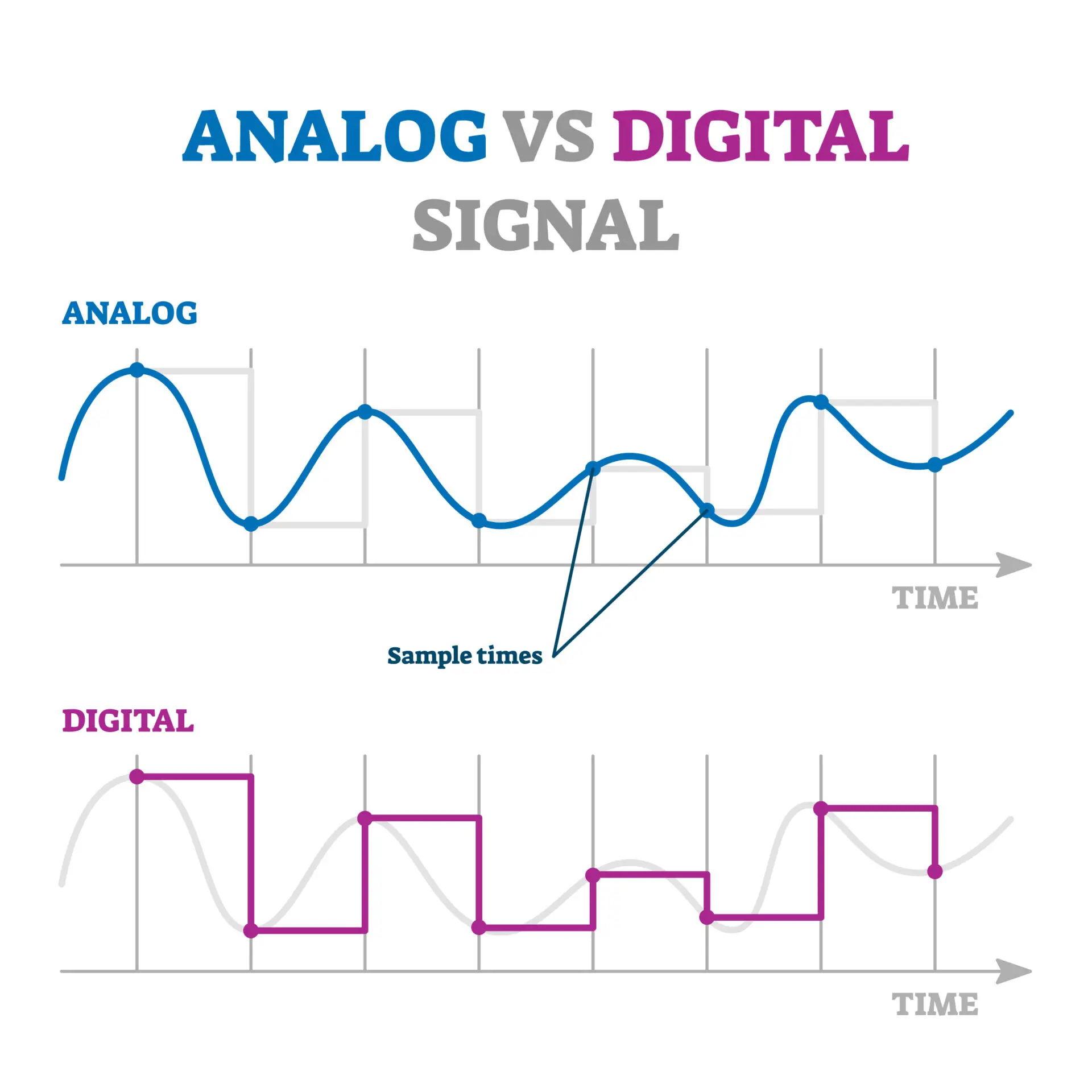
For a very long time the world was run with analog systems: television signals, radios, record players, telephones and much more. Analog systems came with many difficulties of ensuring the message will get through nice and clear. There was no way to differentiate between a signal and noise, which is why if you remember old television sets they would have “salt and pepper” on the screen in front of the show playing if you were close, but not exactly on the correct channel. Switching to a digital signal got rid of this anomaly, there was a way to differentiate between signal and noise using 1s and 0s, binary code. One invention that laid the foundation for digital technology was the microchip and the semiconductor transistor. The late 1950s invention changed the way technology was used especially in computers. The transition to digital paved the way for technology that is used everywhere today; like cell phones, personal computers and access to the internet.
So let’s dive into some new and old digital representations of the world that we live in and the limitations behind them.
Samuel Morse and Alfred Vail developed the telegraph with the use of Morse code in 1838. The telegraph was a digital system that used dashes and dots to communicate messages with other telegraphs, by representing letters in the alphabet. A group of dashes and dots each stood for a different letter or punctuation. In history, it changed the way long-distance businesses were able to communicate. People didn’t have to drive to share news anymore, which takes time, they could type out what they wanted to say and the other person would decipher the message and learn the news quicker. There were still a few limitations, of course, in that time telegraphs were expensive and not everyone was able to get their hands on one. It was also a learning curve, it’s not just like reading what someone has written, you must learn Morse code and what the different dashes and dots stood for. With that being said this was a more efficient way of communicating than other technology at the time and paved the way for modern day communication.
In 1945, the first digital computer, the Electronic Numerical Integrator and Computer (ENIAC), was completed. This groundbreaking device was developed following the failure of the Norden Bombsight, an analog computer that had been used during World War II. The analog computer used had so many different parts to it, so the inaccuracies of those parts added all together resulting in incorrect results for the bombing. The ENIAC, however, addressed many of the issues associated with analog computers by providing exact, precise, and repeatable results. It allowed users to identify and correct errors in calculations as they occurred, highlighting the importance of digital computations.
In closer to modern day time,2009, the Federal Communications Commission (FCC) initiated the transition from analog to digital televisions. This shift enabled the availability of more channels and allowed smaller dishes to receive frequencies from various stations. Digital TVs effectively eliminated static and noise from weak signals, as the digital signal was binary – it was either available or not. This transition marked a significant improvement in the quality and reliability of television broadcasts.
Digital representations in history have challenges and limitations, it depended on bandwidth to transmit information. It can only send so many symbols per second. If there was a need for encryption of messages it is easier for others to decode the message and figure out what is being communicated.